
Origin & Quality
From the flax field to the finished fabric
From the flax fields of Normandy to the flax retting pits in Belgium and the linen mills of Eastern Europe: how good linen is made, what certifications really mean, and why there are hardly any mills left in Europe. Eight entries covering everything that happens between cultivation and the finished fabric.
Why is European linen better than Asian linen?
“Better” is the wrong word—a more accurate term would be “different.” But the difference is fundamental, and it doesn’t begin in the weaving mill, but in the field.
The world’s finest fiber flax grows along a coastal strip stretching from Normandy to Flanders. The humid Atlantic winds, the dewy mornings, the mild summers—these are not merely sentimental advantages of the location, but production conditions that directly influence fiber quality. Cooler, more consistent growth produces longer, more uniform fiber bundles. Field curing works better on the Atlantic coast than almost anywhere else because humidity and temperature interact optimally.
Asian flax—primarily from China—is grown under different climatic conditions, often in nutrient-rich soils that accelerate growth but result in thicker fibers. Subsequent processing often involves chemical retting rather than field retting, which is faster but produces coarser fibers. This is frequently followed by cottonization: the long fibers are mechanically cut to cotton length so they can be processed on more economical cotton spinning machines.
The result: Two sheets labeled “100% linen” can differ significantly after ten years of use—one develops a patina, the other does not.
What is the difference between natural and chemical roasting?
Scutching is the most critical step in the process of turning flax stalks into fiber—and the one that has the greatest impact on quality and sustainability.
Dew retting (field retting): After harvesting, the flax is laid out in swaths in the field. Dew, rain, and changes in sunlight create a microclimate in which fungi and bacteria slowly break down the pectin. The process takes three to six weeks, requires no energy other than sunlight and rain, and produces no wastewater. The resulting fiber has a natural suppleness that no other process can achieve.
Chemical retting: The pectin is broken down using acids or enzymes—in hours rather than weeks. The process is predictable and not dependent on weather conditions, but it robs the fibers of their fineness. Chemically retted fibers are coarser, stiffer, and less supple. The accompanying substances—lignin, phenolic acids—are largely removed in the process. No European quality manufacturer uses chemical retting.
Today, the main areas of European fiber flax cultivation are in Normandy and Flanders, where the climatic conditions for field curing are optimal worldwide.
What is the difference between wet and dry spinning—and why does it matter?
If you want to understand why two linen fabrics can differ so greatly even though both are labeled “100% linen,” you’ll often find the answer here.
Wet spinning: Before spinning, the flax fibers are immersed in a bath of warm water—60 to 70 degrees Celsius. The water dissolves pectin residues and makes the fibers supple. The softened fibers can be drawn out more finely and twisted more evenly. The result: a yarn with minimal fuzz, uniform thickness, and a surface that creates the silky sheen in the finished fabric that characterizes fine linen.
Dry spinning: The fiber is spun without a water bath—resulting in a rougher, hairier texture. This is the ideal yarn for upholstery fabrics, canvas, and technical textiles. Not suitable for bedding.
The yarn’s fineness is measured in Nm (metric number): the higher the number, the finer the thread. Nm 26 is a sturdy, everyday yarn; Nm 40 is the standard for high-quality linen bedding; and Nm 60 and above is what you can really feel against your skin—firm yet soft.
What is cotonization—and why should I know about it?
Sizing is the most commonly overlooked quality decision in linen processing.
The long fibers of flax—up to 90 centimeters long, painstakingly extracted through retting, breaking, scutching, and hackling—are chemically and mechanically shortened to the length of cotton fibers: three to four centimeters. This allows them to be processed on inexpensive cotton spinning machines. The result is cheaper, faster, and suitable for mass production.
What is lost: the strength derived from the fiber length. The smoothness of the long, parallel fibrils. The durability that comes from an unbroken thread without weak points. The material memory. Cottonized linen ages like cotton—not like linen.
The problem for the buyer: The label still says “Linen” or “Lin.” The linen content justifies the product name, even if the cottonization has destroyed all the fiber’s specific properties.
The manufacturers at The Linen Lounge—Leitner, Libeco, Schlitzer, Hoffmann, Vieböck, Geniksa—do not use cotton. This is not a given. It is a conscious choice.
Two sheets labeled “100% linen” can look completely different after ten years of use—one develops a rich patina, while the other does not.
What do linen certificates really tell us?
Certifications are guidelines, not guarantees. Each one covers something different—and none of them covers everything.
European Flax®: A seal of origin for flax from Western Europe (France, Belgium, the Netherlands). Guaranteed: grown in accordance with European standards, field-cured, and free of GMO varieties. Not guaranteed: that the processing—spinning and weaving—took place in Europe.
Masters of Linen®: It goes further. The entire production chain—from the field to the finished fabric—must take place in Europe. The most prestigious seal of origin and quality for European linen.
GOTS (Global Organic Textile Standard): Certifies that the entire supply chain adheres to organic farming practices, environmentally friendly processing, and social standards. It is the most comprehensive certification for environmentally and socially responsible production—but it says nothing about fiber quality or the location of processing.
OEKO-TEX Standard 100: Tests the final product for harmful substances. Guarantees: The textile contains no substances harmful to health. Does not guarantee: origin, sustainability, or fiber quality.
Full transparency—flax from Normandy, spun in Belgium, woven in Austria—is worth more than any seal, because it allows for a level of verification that no logo can provide.
What do thread count and weight per square yard mean for linen?
Two numbers that reveal a lot—if you interpret them correctly.
The weight per square meter (in g/m²) indicates how much the fabric weighs. For bedding: 120–180 g/m² for lightweight summer linen, 180–250 g/m² for all-season sheets, and 250+ g/m² for heavy table linens. A higher weight isn’t necessarily better.
Thread count indicates how many threads are woven per centimeter. Here’s the most common mistake people make when comparing linens: the cotton standard (the higher the thread count, the better) doesn’t apply to linen. Flax fibers are significantly thicker than cotton—20 warp threads per centimeter in linen result in a dense, sturdy weave.
The most reliable way to test quality is an old and simple one: hold it up to the light. With good linen, the threads lie close together and are evenly spaced. Pliny the Elder recommended biting the thread: a good linen thread emits a clear, high-pitched sound when bitten. This test is two thousand years old. It still works.
Why are there so few linen mills left in Europe?
The question touches on one of the most sobering realities for anyone who buys fine European linen and understands the supply chain behind it.
Long flax fibers can only be spun into fine yarns using a wet process—a labor-intensive procedure in which the fibers are passed through a hot water bath. These specialized machines are expensive to purchase and operate. As the textile industry shifted to Asia in the 20th century, European flax spinning mills also disappeared. Today, there are only a handful of mills left throughout Europe. France, which grows 75 percent of the world’s fiber flax, has virtually no spinning capacity left within its own borders.
This has a concrete implication for the buyer: even a sheet bearing the “Made in Europe” label may be made from yarn spun in China. Only “Masters of Linen” guarantees a fully European production chain.
This scarcity is also the real reason why high-quality European linen comes at a price. It’s not about exclusivity or marketing—it’s the actual scarcity of a processing infrastructure that has been dismantled over decades.
What does the price tell us about the quality of a linen item?
The price of a linen fabric tells a story—if you can read it.
Broadly speaking, the costs break down as follows: about 30 percent for the fiber, 15 percent for spinning, 25 percent for weaving, 15 percent for finishing, and 15 percent for sales and logistics. Anyone familiar with this process knows that cost-cutting almost always occurs in the fiber and spinning stages—the largest cost centers and the ones that determine quality.
If a linen bedsheet costs less than 60 euros, you should ask which steps were skipped: short-staple cotton instead of long-staple, dry spinning instead of wet processing, chemical bleaching instead of sun bleaching. The result is evident as soon as you unpack it. It ages differently.
Often, the 300 euros you pay isn’t for the fabric itself, but for the store’s reputation. In between lies the range where good linen commands a fair price—made with European long-staple fibers, wet-spun yarns, and a transparent supply chain. What you get in return: a sheet that lasts 20 to 30 years and gets better with each passing year. The math speaks for itself.
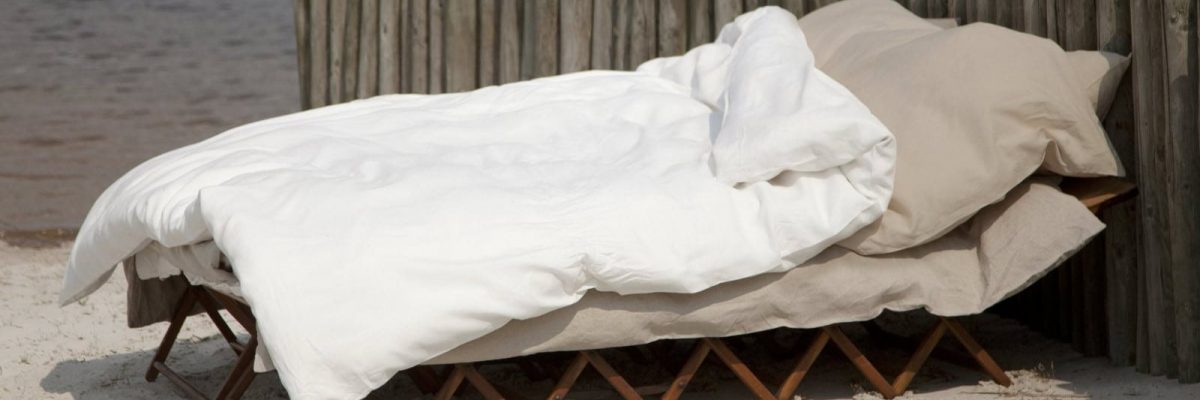
- Every manufacturer at The Linen Lounge uses European long-staple flax and wet-spun yarn, with a fully transparent supply chain. View the bedding collection →
Related Topics
What is linen?
Fiber Properties, Material Comparisons, and Design
Care & Durability
Washing, drying, ironing, and actual lifespan
Sustainability
Life Cycle Assessment, Water Consumption, and Why Durability Matters
