
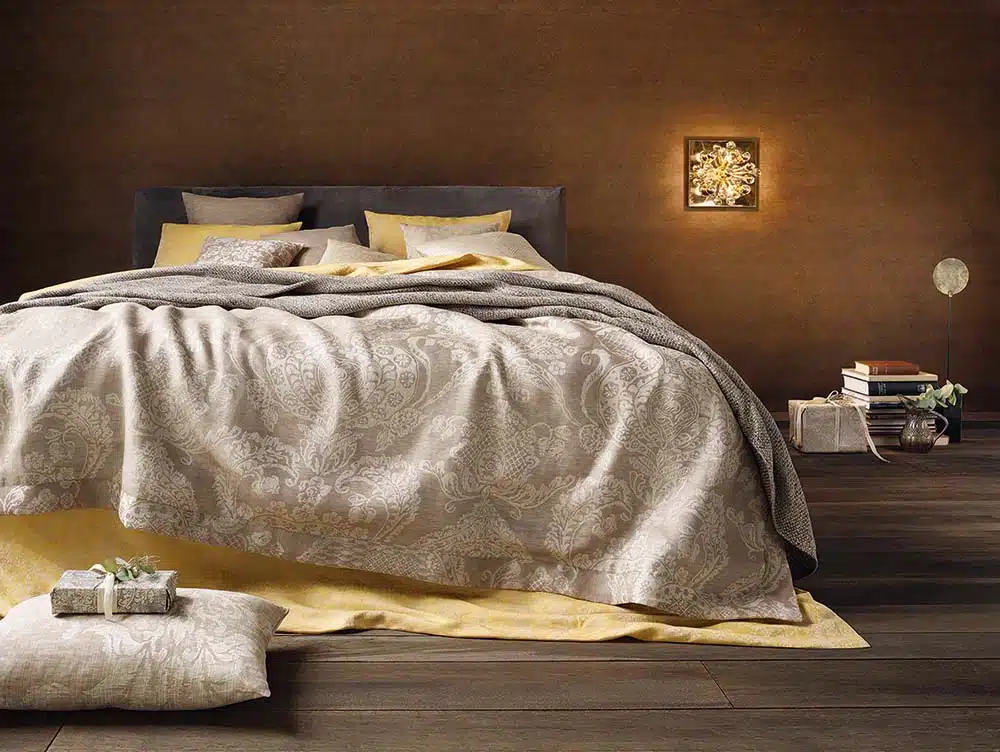
What makes linen special
Linen is the queen of fabrics. Quite often, returning to tradition really is the better choice. Before cotton arrived in Europe, household linens here were mainly made of linen, which is produced from flax. Flax is obtained from the fibres of the flax plant and is considered one of the highest-quality fabrics. It feels cool in summer, keeps you warm in low temperatures, and has sterilising properties—meaning it is antibacterial and antiviral. Linen is naturally antistatic and absorbs dirt. Functionally, it is the ideal choice for bed linen. Visually, linen stands out with a fine, smooth sheen and delicate creases, so overall it offers real advantages both to the touch and to the eye.
The Leitner linen manufactory has elevated working with linen into a true art. Since 1853, the Leitner linen manufactory has been producing timeless products that are hard to surpass in design, standards, and craftsmanship.
Leitner Leinen has been based in the Bohemian Forest for almost 160 years. The small towns of Mühlviertel and Ulrichsberg in Austria are places where beautiful linen fabrics are made—the office and site of one of Europe’s leading linen textile manufacturers. The name Leitner Leinen stands for the finest natural yarn and high-quality design, which is certainly no small claim. It was only the commitment of the current owner, Friedrich Leitner, that turned this practical linen weaving mill in northern Austria into an internationally renowned textile brand.
The family tradition of flax began in 1853.
Leitner was initially a merchant who discovered flax as a commodity. The Leitner linen weaving mill was founded in 1928. To this end, the grandfather of the current owner purchased 24 mechanical looms. In the decades that followed, the family business became Austria’s largest producer of tea towels. In this case, Friedrich Leitner took over the company in 1986. For him, the solid production of home textiles is the foundation for achieving bigger goals. Leitner did not only take over management. He was also concerned with the linen craft. Because: linen is the queen of fabrics.
Linen weaving has a long tradition in the craft industry and is increasingly being overlooked in favour of industrial technology. In the early centuries, linen bed linen was a precious possession, not a sign of wealth. For a long time, high-quality linen weaving has evolved into fascinating weave patterns. Friedrich Leitner hopes to restore the original value of linen textiles to the present day. His goal: to be more likely to produce high-quality linen fabrics for beds and dining tables, to protect old weaving traditions from being forgotten, and to lead linen weaving with the latest technology. Yes: linen is the queen of fabrics.