
Categories
Peter Reed has been producing in Lancashire since 1861 and is traditionally associated with English excellence and luxury. Peter William Reed was a farmer in Barley, on the slopes of Pendle Hill in Lancashire. He began in 1861 with water-powered looms and built the Spenbrook Mill in 1875, one of the first steam-powered factories in Lancashire. His son (William Clay Reed) entered into a partnership around 1885 with another local textile entrepreneur, John Moorby. The two erected a joint mill in 1886 to power the looms, named Narrowgates Mill in Barley. Both Peter Reed and John Moorby operated from this mill until 31 October 1891, when they moved to larger premises down in the new town of Nelson, which was growing up around the Leeds & Liverpool Canal (all coal and cotton arrived by waterway).
The new mill in Nelson was called Springbank Mill and powered what was then the second-largest weaving shed in the world (748 shuttle looms). The company moved in 1968 to Springfield Mill in Blacko and converted the first automatic weaving machines in Great Britain. In 1986, Peter Reed relocated to a new weaving mill in Nelson, Lancashire (called Springfield Mill). In 2003, following a difficult period, the company changed ownership and the new proprietors completely rebranded and revitalised the business. The newly founded Peter Reed Limited (PRL) established a new factory in Burnley, in the heart of the traditional textile region of Lancashire. One of the few factories to have been based in Great Britain for over a century. The Peter Reed brand was rebuilt and produces bedding from 100% Egyptian cotton to the traditional luxury standards established many years ago.
Peter Reed was once again granted the Royal Warrant of Appointment to Her Majesty The Queen as a manufacturer of bed linen in January 2008: an honour of which they are immensely proud.
Peter Reed percale bed linen is produced exclusively from specially selected, premium worsted yarns. Before spinning, shorter cotton fibres are removed during the combing process. This ensures that the yarns are spun only from the longest fibres of the cotton harvest, which enhances the softness of the finished product.
High Thread Count
The thread count of a fabric is the number of intersection points of yarns (warp and weft) in a given area (expressed per square inch or centimetre). Cloths with more than 180 threads per square inch are classified as ‘percales’ and more than 250 per square inch as ‘super percales’. Thread counts are stated after natural wash shrinkage. Thread counts in fabrics containing multi-ply yarns can be misleading, as they do not provide a pure measure of intersections in the weave. Peter Reed fabrics have been produced for many years and have established themselves as the hotel standard. The standard range comprises thread counts of 180, 220, 400 and 540 (the 400 and 540 thread count fabrics are constructed with two-ply yarns).
Woven Edges
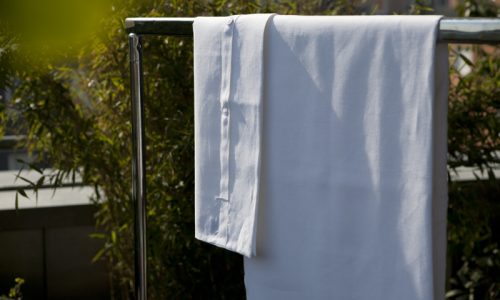
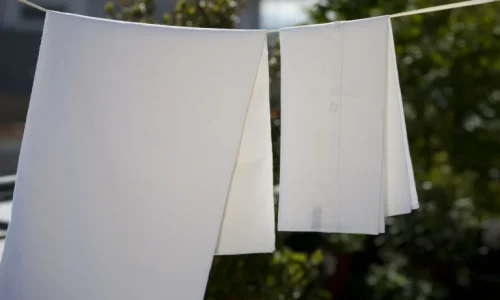
All bleached Peter Reed fabrics are finished, wherever possible, with a special selvedge. A woven selvedge lends the fabric a strong and clean finish that outlasts a merely stitched hem in the wash.
Sizing and Shrinkage Tolerances
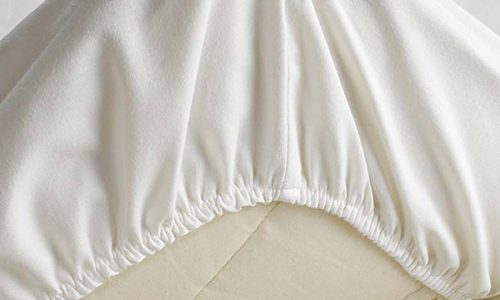
Peter Reed bed sheets are manufactured with excess dimensions, as the sheets will shrink on the first wash. This ensures a sufficient overhang for extra-deep mattresses. King-size sheets are produced at 117″ (295 cm) and super king at a luxurious 126″ (320 cm). Fitted sheets and duvet covers are manufactured allowing for the 5–8% shrinkage that occurs on the first wash. In accordance with industry standards, flat sheets and pillowcases are labelled with the actual sewn dimensions, whilst fitted sheets, valances and duvet covers are labelled with the expected size after shrinkage. Peter Reed fitted sheets are sewn with a generous side skirt that accommodates mattresses up to a depth of 10″ (25 cm); deeper skirts are available upon request.
Generous Hems for Long-Lasting Durability
All Peter Reed hems are stitched with a minimum of 12 stitches per inch to ensure a long service life of the article. The 1¼ inch (3.125 cm) wide bottom hem and the 3 inch (7.65 cm) wide top hem provide high tear resistance and facilitate ironing by hand or by rotary iron.
Cord Stitching
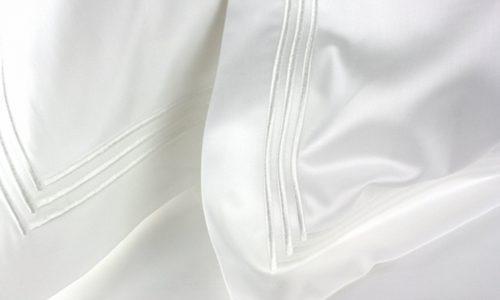
All products in the Peter Reed range are finished with classic cord stitching, sewn at 28 stitches per inch. In the days when all linen was bleached white, different rows of cord stitching were applied to identify the various qualities of the cloths. Peter Reed bed linen continues this tradition today with additional rows of cording for higher thread counts.
Overlock with Safety Stitch
All Peter Reed duvet covers and standard pillowcases are fitted with a double chain stitch and safety stitch for long-lasting durability through washing and bed-making.
Peter Reed ‘Oxford style’ pillowcases with a decorative standing flange around the cover are sewn throughout with traditional mitred corners. Their construction requires the assembly of four separate pieces of fabric and the skilful stitching of these parts. The end result is a standing flange that holds its shape at the corners when placed on the bed, in contrast to the simpler Oxford construction, which can produce a “rabbit ear” effect.
Labelling & Laundry Care
Peter Reed bed linen is supplied with European and US standard washing instructions and also includes a personal sewn-in label for easy identification and household management. Cotton should be washed at the highest possible temperature for best results using a mild detergent. White bed linen up to 90 degrees, coloured bed linen up to 60 degrees. Ironing is recommended whilst the fabric is still damp and turned inside out.
What Else Belongs to the Bed
Peter Reed produces a broad range of articles for the bed, including valances, pillowcases, duvet covers and bed linen. Articles can be made to order in any desired bespoke size.
Peter Reed is the epitome of British bed linen. That the British royal family has an eye for quality is beyond doubt. Since the 1880s, Peter Reed has been a royal warrant holder for the bed linen of the British royals as “Royal Warrant of Appointment to Her Majesty The Queen”.
Peter Reed is one of the most prestigious manufactories for bedroom ensembles worldwide. Not only the British royals sleep in its bed linen; many internationally leading hotels also entrust the sleep of their guests to Peter Reed’s bedding. The production facilities have been relocated back to their former home in Lancashire, and there Peter Reed upholds the high, traditional standards of craftsmanship.
This may have something to do with the fact that Peter Reed uses only the very finest combed cotton from the Nile Delta. This region, with its rich alluvial soil and natural humidity, produces a unique and lustrous cotton growth whose harvest ranks among the finest fibres in the world. Egyptian cotton is ideal for use in bed linen, as it “breathes”, is dust-free and thrives with frequent washing and use.
Long-staple fibres with a length of around 35 mm, woven in Italy and then finished in England into the finest percale bed linen. Only from such long fibres can the yarns be spun that allow the simultaneously fine and dense weave of percale. A hallmark of Peter Reed percale: it does not yellow. Peter Reed manufactures exclusively to order; there is no stock production.
Why the Products of the Peter Reed Weaving Mill Are Your Best Choice at Linen Lounge
Welcome back!
Register now
Some things we show first to those who know how to appreciate them.
First access to new collections. Pre-order limited editions. Behind the scenes of our manufactories.
Welcome back!
Register now
Some things we show first to those who know how to appreciate them.
First access to new collections. Pre-order limited editions. Behind the scenes of our manufactories.