






Trousseau is not an old-fashioned word. It is a material idea.
There are wedding gifts that sit in the closet after a year. The Thermomix that no one uses. The vase that doesn’t match anything. The voucher that expires. And then there are gifts that begin on the wedding day and are better twenty years later than on the first day. Gifts that don’t sit in the closet, but lie in the bed, on the table, in one’s hands — night after night, wash after wash, until they belong so much to that one household that no other fabric could replace them.
That is linen. And that is the idea behind the word trousseau: not sentiment, but material. Fabrics that are good enough to be passed down because they don’t get worse with time, but better.
Why Linen Can Outlast the Marriage
In the trousseau chests of Central Europe lay linen that mothers bequeathed to their daughters — not as a keepsake, but as everyday linen that was still better after twenty years than anything one could have bought new. This knowledge was lost with the cotton era. The idea that bed linen is a consumable item that is replaced every few years is not a natural constant. It is a habit two hundred years old — as old as industrial cotton.
Linen follows a different logic. The flax fiber is naturally encased in a fine pectin layer that makes the fresh fabric stiff. With each wash, this layer dissolves a little. The fibers swing more freely, cling more closely, reflect light more warmly. After weeks, the fabric feels different than on the wedding day. After months, it is different. After years, it is the best thing that has ever rested on this skin — adapted to the body that sleeps on it, to the washing habits of the household, to the water of the region where it is washed.
Material science calls it hysteresis. We call it material memory: the fabric stores how it was used and gives it back. No other sheet in the world will feel the same then. This is not a sentimental statement. It is a measurable fact — and it is why linen is the wedding gift that accompanies the marriage instead of disappearing into it.
A good linen sheet withstands more than a thousand washes. A cotton sheet manages two to three hundred. These are not just numbers. This is the difference between a gift that lasts and one that is replaced.
What to Give — and What Matters
Whoever gives linen as a wedding gift is not simply giving bed linen. They are giving a beginning — a fabric that, on the day of its handover, is not yet what it will become. One must know this, and it is perfectly acceptable to say so: This gift will get better the longer you use it. In a year, you will understand why.
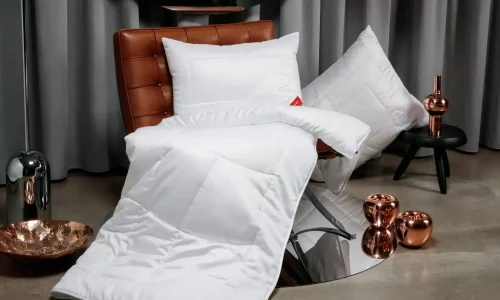
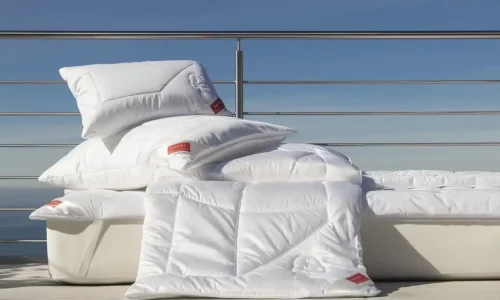
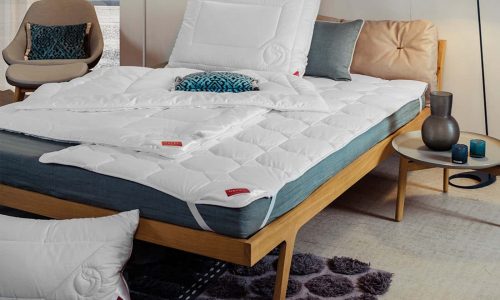
Bed linen is the most obvious and most effective gift. A set of pure linen — duvet cover and pillowcases — with a fabric weight of 180 to 220 g/m² is the year-round quality that requires no seasonal change and lasts two decades. If you wish to give more generously, choose a second set in a lighter summer weight — 150 to 180 g/m² — so the couple is equipped for both seasons from the start.
Table linen is the gift for those who love to entertain. A pure linen tablecloth in damask or plain weave, with matching napkins — that is the table that makes every evening more special than it would be without this fabric. Half-linen is a smart alternative here: easier to care for, softer from the start, and for a household just beginning, a choice without regret.
What not to give: Individual items without context. A single pillow without a cover, a table runner without table dimensions, a fabric in a guessed color. Linen is a personal material — it adapts to its owner, and it helps if the owner was involved in the choice. A gift voucher from a manufacturer or specialist retailer is not a makeshift solution. It is the smartest way to give: specify the material, leave the choice.
Where to Buy — and What the Price Tells You
The price of a piece of linen tells a story — if you can read it.
Roughly, costs are distributed as follows: about thirty percent for the fiber, fifteen for spinning, twenty-five for weaving, fifteen for finishing, and fifteen for sales and logistics. Savings are almost always made on fiber and spinning — the largest cost centers and the quality-determining factors. Cottonized short fiber instead of long fiber, dry spinning instead of wet processes, chemical retting instead of field retting. The result looks similar when unpacked. It ages differently.
Three questions help to read the price: Where does the fiber come from? Where was it processed? What is the fabric weight? A linen bed linen set with European flax, a European processing chain, and 200 g/m² upwards justifies its price. A product without origin information, under 180 g/m², with “Easy Care” finish — that’s a different story.
The long-term calculation: A linen set for three hundred euros that lasts twenty years costs fifteen euros per year. Three cotton sets for sixty euros each, replaced every four years, cost over three hundred euros in the same twenty years — and leave five times the ecological footprint. The higher price of linen is not a premium for luxury. It is a premium for time.
Three Linen Manufacturers for the Wedding Gift
Hoffmann from Upper Lusatia has been weaving linen damask in the same building since 1905. The chrysanthemum, the oldest design, has been produced since its founding — a pattern that shimmers on the fabric and changes with the light, as if breathing. Hoffmann is the choice for couples who know what a trousseau is — not as a tradition, but as an attitude. For table linen that is inherited. For bed linen that accompanies the beginning of a family, because it is good enough to still be there when the children move out.
Leitner Leinen from Mühlviertel brings jacquard designs of a depth that other looms cannot achieve — forty threads per centimeter, patterns from Bohemian archives, translated into contemporary linen. Seamless bed sheets in full width, no weak points, even aging over decades. For couples who love ornament that tells a story without being loud. For fabric that has a history before their own begins.
Libeco from Meulebeke, Flanders, is the classic for casual elegance — Belgian linen that is allowed and meant to wrinkle, because wrinkling at Libeco means: Someone has lived in it. Wide color palette, natural tones, collections that work just as well in Brooklyn as on the Belgian coast. Purveyor to the Belgian Royal Court and GOTS-certified, over ninety percent European yarn. For couples who do not see casualness and seriousness as a contradiction.
The Trousseau as a Counter-Concept
There’s a reason why the word trousseau sounds old-fashioned: it comes from a time when things were built to last. When people didn’t ask if something would still be liked next year, but if it would still hold up in twenty years. When the value of a gift was measured not by its price, but by the time it endured.
Linen fits into this logic because it originates from it. It is a fabric that offers no quick gratification — stiff at the beginning, demanding patience, earning its softness rather than bringing it with it. But what it gives after this acclimatization, no other material can give: a fabric that clings more closely to the life that uses it with each passing year.
The trousseau is not nostalgia. It is a counter-concept to the disposable wedding — and linen is its material.
Which linen bed linen is suitable as a wedding gift?
Pure linen from European long fiber with a fabric weight of 180 to 220 g/m² — the year-round quality that requires no seasonal change and lasts twenty to thirty years. A set consisting of a duvet cover and pillowcases is the most effective gift.
Where can one buy high-quality linen bed linen?
From specialist retailers and manufacturers who transparently state European origin, processing chain, and fabric weight. Three questions clarify quality: Where does the fiber come from? Where was it processed? What is the fabric weight?
Isn't linen too expensive as a wedding gift?
The long-term calculation shows the opposite. A linen set for three hundred euros that lasts twenty years costs fifteen euros per year. Three cotton sets over the same period cost more and leave five times the ecological footprint.
Why is linen stiff at first — is that normal?
Yes. The pectin layer of the flax fiber dissolves with each wash; the fabric becomes softer, more supple, more pliable. After five to ten washes, the change is clearly noticeable. More on this under Care & Durability. Linen does not reward the first touch — it rewards the hundredth.
Which linen fabrics are particularly durable?
Pure linen from wet-spun long-fiber yarn with a fabric weight of 200 g/m² or more. Flax fiber withstands more than a thousand washes and becomes softer rather than weaker. The origin is crucial: European flax, field retting, no cottonization.
What is the difference between manufacturer and department store linen?
Manufacturers use European long fiber, wet-spun yarns, and transparent supply chains. Department store linen often comes from cottonized short fiber — mechanically shortened to cotton length, cheaper to produce, but without the longevity and material memory that characterizes linen. Both labels state “100% Linen.” The difference becomes apparent after ten years.