This really helps with allergies

People with allergies are looking for solutions.

The textile industry offers them promises. One is not the same as the other.

Anyone who wakes up at night with a blocked nose, sneezes in the morning, and rubs their eyes thinks of pollen, dust, and house dust mites. Rarely does anyone think of bed linen. Yet you spend eight hours a night with your face on the pillow, breathing through the fabric, touching it with the most sensitive skin on your body. What lies directly against your head is not just a matter of comfort for allergy sufferers. It is a matter of avoiding triggers.

This article distinguishes between what research actually says about linen and allergies, and what advertising has made of it. The two are closer than you might think—and further apart than most manufacturers would like.

What really happens in bed: the mite problem

The house dust mite is neither an insect nor a parasite. It is an arachnid about a third of a millimetre long that feeds on shed skin flakes and lives in warm, humid cavities. A person sheds around 1.5 grams of skin flakes per night—enough to feed 1.5 million mites. The bedroom is their preferred habitat: mattress, pillow, duvet, covers.

The allergen is not the mite itself. It is its droppings—microscopic particles that become airborne when you shake out the bed linen or turn the pillow. Depending on the source, between 10% and 15% of the population in Germany is sensitised to house dust mites. Among people with asthma, the proportion is higher.

So the question is not whether you have mites in your bed—you do. The question is whether you provide them with a favourable climate or an unfavourable one. And this is exactly where the role of the material begins.

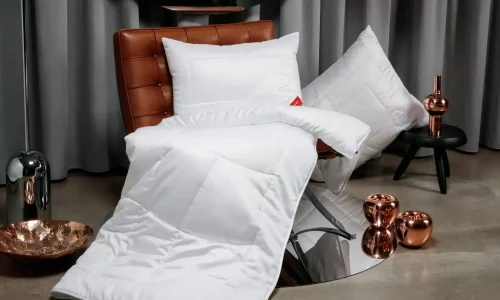
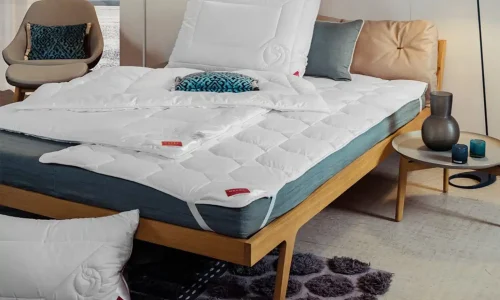
A woman lying on a bed with pillows.

Why linen is an unfavourable place for mites

House dust mites need three things: warmth, moisture, and cavities. In dense, warm, humid fabric, they multiply. In dry, smooth, well-ventilated fabric, they have a harder time.

Flax fibre naturally has properties that create this unfavourable environment. It is smooth—significantly smoother than cotton, whose surface under the microscope resembles a twisted, roughened ribbon. This smoothness has two effects: less mechanical friction on sensitive skin, and a smaller surface area for allergens, pollen, or fine dust to cling to.

Gleichzeitig reguliert Leinen Feuchtigkeit aktiver als jedes andere Naturtextil. The fiber wicks sweat away from the skin rather than trapping it. The bed microclimate—that thin layer of air between skin and fabric—remains drier than with cotton or polyester. For dust mites, this means a less hospitable environment overall and a reduced food source, as skin flakes dry out more quickly.

Linen’s dense weave structure adds to this. The denser the weave, the fewer cavities there are to serve as nesting sites. High-quality pure linen with a thread count of twenty or more threads per centimetre physically leaves less room than loosely woven cotton or synthetic fleece fabrics, which practically invite mites in.

What research says—and what it does not

A Polish study by Zimniewska and Goślińska-Kuźniarek (2016) examined the allergic activity of various textile fibres and documented a “lack of allergic activity” in linen fabric. Put precisely: linen itself does not trigger allergic reactions.

That is a different claim from “actively protects against allergies.” The difference matters. Linen is not a medicine. It does not eliminate mites, it does not kill allergens, and it does not replace an encasing cover that acts as a physical barrier between mattress and sleeper. What it does do: it provides a microclimate that is less favourable for mites than other materials, and a fibre surface that binds fewer allergens. That is physical plausibility, not a clinical guarantee—but it can be highly relevant for allergy sufferers who do not tolerate cotton or polyester well.

In addition, in vitro studies (Gębarowski et al., 2020) showed that flax fibres can stimulate the proliferation of fibroblasts—those cells responsible for skin tissue repair. The fibre contains biologically active accompanying substances: phenolic acids, phytosterols, lignin. The more natural the linen, the more of these substances remain. Heavily bleached or chemically treated linen has largely lost them.

Hippocrates used linen for inflammation. Modern research has confirmed the intuition—within a more specific framework than marketing would like.


A woman lying on a bed with white sheets.

What other materials mean for allergy sufferers

Cotton is softer, but more problematic. Its roughened fibre surface binds more particles, the fabric dries more slowly, and loosely woven cotton offers mites ideal cavities. Woven percale cotton with a high thread count is better than jersey, but in direct comparison, flax fibre remains the smoother and drier choice.

Polyester does not absorb moisture—at first glance, an advantage against mites. In practice, sweat remains on the skin surface, the bed climate becomes humid and warm, and the mite still finds what it needs. Synthetic fibres also build up static electricity and attract fine dust and pollen—the opposite of what an allergy sufferer needs.

Silk has a very smooth fibre surface and is sometimes recommended as allergy-friendly. The recommendation has a basis, but silk is sensitive to moisture and washing—and allergy sufferers need to wash their bed linen frequently and at high temperatures. Linen easily tolerates 60°C; silk does not.

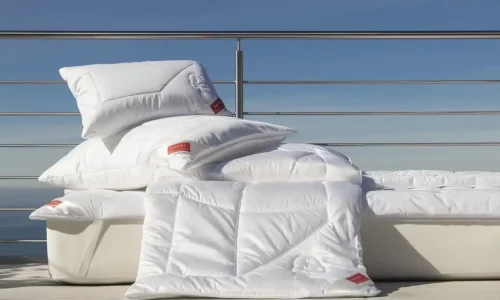
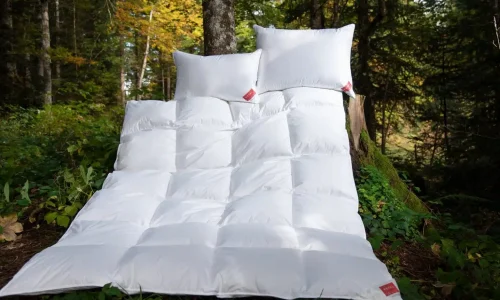
Two white pillows stacked on top of each other.

What allergy sufferers should really look for when choosing

The material alone is one factor—but not the only one. If you are an allergy sufferer considering new bed linen, you should keep several things in mind.

The pillow is the most critical point. It is located right on the face, where the mucous membranes are most sensitive. A linen pillowcase made from heavy-weight pure linen — at least 180 g/m², undyed or reactive-dyed — provides the smoothest, lowest-allergen surface in the most sensitive area. For those with severe house dust allergies, an encasing liner placed between the pillow and the linen cover provides additional protection.

Washability is decisive. People with allergies should wash their bed linen every one to two weeks at a minimum temperature of 60 degrees. Linen can withstand this without any loss of quality — in fact, it actually improves. Fabrics that can only be washed at 30 or 40 degrees are unsuitable for people with allergies, as dust mites are only reliably killed at temperatures of 58 degrees or higher.

Finishing matters. Untreated or gently processed pure linen retains its natural antibacterial properties. It has lost its heavily bleached, chemically treated fabric. Anyone wishing to benefit from linen’s hypoallergenic properties should look for European long-staple fibre and gentle processing — not the cheapest label bearing the words ‘100% linen’.

Certificates help with orientation. OEKO-TEX Standard 100 garantiert Schadstofffreiheit — wichtig für empfindliche Haut. GOTS goes a step further and audits the entire supply chain. Masters of Linen guarantees European manufacturing. Neither of these labels makes any claims regarding suitability for allergy sufferers in a medical sense — but they do increase the likelihood of receiving a product that has been manufactured to high standards.

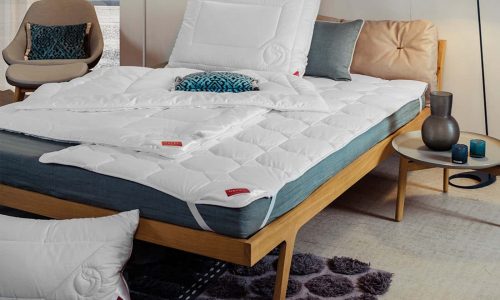
A bed with two pillows and a bedside table.

What linen cannot do—and what it can do all the better

Linen is not an allergy medicine. It is not a substitute for medical diagnosis, not an alternative to encasing in cases of severe house dust allergy, and not a miracle cure for hay fever. If you read such claims, you are reading advertising, not science.

What linen can do: create a sleep environment that is physically less burdened by allergens than the common alternatives. It binds fewer particles, dries faster, offers mites less habitat, and irritates sensitive skin less. It tolerates the wash temperatures allergy sufferers need. And it does not get worse in the process, but better—softer, smoother, denser.

The Zimniewska study put it soberly: “lack of allergic activity.” That may not sound like much. For someone who breathes through the fabric every night, with their face resting on it, it is a lot.

Frequently Asked Questions:
Is linen bed linen hypoallergenic?

According to current research, flax fibre itself does not trigger allergic reactions (Zimniewska/Goślińska-Kuźniarek, 2016). However, the term “hypoallergenic” is not a protected medical term. What can be said: the smooth fibre surface binds fewer allergens, the fabric dries faster, and it provides a less favourable climate for house dust mites than cotton or polyester.

Dense pure linen made from European long fibres, at least 180 g/m², washable at 60°C. In addition, for severe house dust allergy: an encasing inner cover for the mattress and pillow. Polyester is unsuitable despite its moisture resistance, because it binds fine dust electrostatically and worsens the bed climate.

Pillows with a dense linen cover made from untreated or reactively dyed pure linen. The pillow lies directly against the face and airways—this is where fibre quality matters most. In cases of severe allergy, an encasing inner cover between the pillow and the linen cover is recommended.

No. Linen does not kill mites. What it does: it deprives them of a favourable climate—through faster moisture wicking, less warmth, and a denser weave structure with fewer cavities. When washed at 60°C, the mites are killed—and linen tolerates this temperature without any problem.

The physical plausibility is strong: smooth fibre, low potential for allergens to adhere, mite-unfriendly microclimate. A Polish study documented a “lack of allergic activity” in linen fabric. However, a large-scale clinical study that tests linen specifically as an intervention for allergy sufferers is still pending.

Yes. House dust mites only die reliably from 58°C. Linen tolerates 60°C without any loss of quality—it even becomes softer and more supple. Materials that can only be washed at 30°C or 40°C are not recommended for allergy sufferers.

Share

More Posts

The Cygna Classic linen sheet from Geniksa is neatly folded and shown against a clean white background.
Hoffmann Linen Weaving Mill – the classics

This bed linen from the Hoffmann linen weaving mill is as good as the trousseau your grandmother received. The linen bedding from the Hoffmann linen weaving mill is made from 100% pure linen. Linen bedding from Hoffmann has a climate-regulating effect, absorbs moisture and wicks it away in a controlled

Read more »
A woven basket filled with various freshly picked wild mushrooms lying in the grass. The mushrooms are different sizes and come in shades of brown, beige and orange.
A passion for mushrooms

Mushrooms can be a real passion True mushroom enthusiasts are already in the forest at sunrise. When I was young, I used to go mushroom picking with my grandfather in my native Weserbergland region. Even today, I still rely on high-quality local delicacies and nutritional trends such as mushroom skewers

Read more »
A woman is holding a blanket over a bed.
The all-rounder deck thing

Some call it a plaid, others just a blanket. Either way, it’s a real all-rounder! Sometimes it’s hot in Germany in summer, not only during the day when the sun is shining, but also at night—then the temperatures plummet and cool rain falls from the sky. So how can you

Read more »

RELATED TO THIS POST

Our Recommendations

Hand-picked products from European manufacturers

Welcome back!

Register now

Before it begins

Some things we show first to those who know how to appreciate them.

  • Priority access to new collections.
  • Exclusive discounts.
  • Pre-order limited editions.
  • Insights into the work of our workshops
Newsletter Anmeldung

Welcome back!

Register now

Before it begins

Some things we show first to those who know how to appreciate them.

  • Priority access to new collections.
  • Exclusive discounts.
  • Pre-order limited editions.
  • Insights into the work of our workshops
Newsletter Anmeldung