Tropical nights – How to sleep better in hot weather

A tropical night — meteorologically defined as a night in which the temperature does not fall below 20 degrees — has long since ceased to be an exception in German cities. In the heatwaves of recent years, up to twenty tropical nights per season were measured in Frankfurt, Cologne, and Berlin. In the urban canyons of city centers, where facades heated during the day radiate warmth back at night, there can be even more.

The consequence is well known: you lie awake, toss and turn, sweat, and cannot find sleep. You look for solutions — from fans and air conditioning to putting pajamas in the refrigerator. Most of these tips treat symptoms. What is rarely asked: What actually happens between the body and the bedding when it is too warm? And why does the material you lie on decide whether you sleep or not? The answer has a name: Linen bedding in summer.

What Happens to the Body During a Hot Night

Sleep begins with cooling. The hypothalamus — the body’s temperature control center in the brain — lowers the core temperature by about one degree Celsius in the evening. This is not a side effect, but a prerequisite: without this drop in temperature, the body cannot enter the deep sleep phases that are crucial for recovery and immune function. Sleep research is unanimous: if you do not cool down, you do not sleep deeply.

To lower the core temperature, the body dilates the blood vessels at the periphery — in the hands, feet, and ears. The blood flows to the surface and radiates heat. Simultaneously, evaporative cooling begins via the skin: up to half a liter of moisture per night, distributed over around 35 percent of the body surface. You change position up to 30 times in a night — every turn brings new areas of skin into contact with the fabric. In the heat, the amount of moisture increases, position changes become more frequent, and the need for cooling grows.

The problem does not begin with sweating. It begins when the moisture cannot escape. Between the skin and the fabric lies a zone of one to two centimeters — the bed microclimate. In this narrow layer, it is decided whether evaporation works or not. If the bedding absorbs the moisture and wicks it away, this zone remains dry and cool. If it stores or blocks the moisture, a damp, warm film is created that the body cannot regulate. You sweat more, the bedding becomes clammy, the core temperature remains high — and sleep remains elusive.

The cycle intended to cool overheats. And the material surrounding the body determines whether it does so.

A bed standing on a sandy beach directly by the sea.

Linen Bedding in Summer: What Research Says About the Cooling Effect

The cooling effect of linen is not folklore. It is the best-documented property of the material and the main reason why linen bedding in summer has been the primary remedy for hot nights for centuries — long before fans and air conditioning existed.

A comparative study by the CETELOR laboratory at the University of Lorraine tested linen, cotton, viscose, and polyester in four categories: air permeability, water vapor permeability, moisture absorption, and drying speed. Linen led in three of them — only in drying speed was viscose slightly ahead.

The mechanism behind it is simple but effective: the linen fiber actively transports moisture to the outside instead of storing it. This capillary transport creates evaporative cooling — the moisture evaporates on the outside of the fabric, drawing in cooler air, and the body is relieved. A 2013 Japanese study confirmed the effect under sleeping conditions: at temperatures of 29 to 30 degrees, linen bedding measurably improved thermal comfort compared to cotton. Read more in our post on the unique properties of linen.

The prophet Ezekiel described linen 2,600 years ago as the material that “does not cause sweat.” Materials science has since measured this. He was right.

Why Cotton and Polyester Fail in the Heat

Cotton absorbs moisture — this is indisputable and is often cited as an argument for summer bedding. However, it releases it more slowly than linen. The result: on a hot night, cotton becomes soaked and remains damp. The sheet sticks, and cooling stalls. Cotton stores water. Linen transports it. Those who wish to compare the materials in detail will find a direct comparison in the article Tencel, Linen, and Cotton Compared.

Polyester absorbs almost no moisture. Sweat remains on the skin surface, and the microclimate becomes a greenhouse. It is the worst possible choice for warm nights — and yet the most frequently sold.

Silk cools well initially but is sensitive to moisture and loses its luster and structure with regular sweating. For the heat phase of a summer, it is a luxury solution with limited durability.

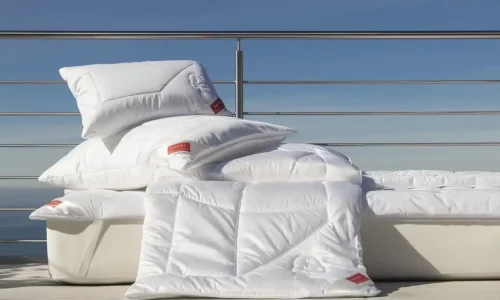
A bed with a white comforter and two pillows.

The Right Basis Weight for Linen Bedding in Summer

Not every linen is summer linen. The basis weight determines how cool or warm the fabric feels. Anyone looking for linen bedding for the summer should specifically look for this specification.

150 to 180 g/m² — Light Summer Linen

For tropical nights and warm bedrooms, linen in the range of 150 to 180 grams per square meter is suitable: light, airy, with maximum moisture permeability. In this weight range, you feel the coolness of the linen most clearly — the characteristic cool touch upon first contact, which remains even when the bedroom is 26 degrees.

180 to 220 g/m² — All-Season Quality

Those looking for an all-season quality that also works in summer should choose 180 to 220 g/m². This is the range that most European manufacturers of the European Flax association use for their bedding collections — heavy enough for durability, light enough for the warm months.

From 220 g/m² — Winter Quality

Heavier qualities from 220 g/m² are intended for cool bedrooms and winter months. In the height of summer, they are too warm.

A higher weight does not automatically mean higher quality. A light fabric made from fine long-fiber yarn can be of higher quality than a heavy one made from coarse short-fiber. The weight describes suitability, not value.

Further Measures for Better Nights in the Heat

Bedding is the most important factor — but not the only one. A few measures that, in combination with linen bedding in summer, make a difference:

Darken the bedroom during the day: close curtains, avoid direct sunlight. Only ventilate in the morning and late evening when the outside temperature is below the room temperature. Those who only open the window at night draw in the radiated heat from the facade.

Use a light summer duvet instead of sleeping without a cover. It sounds paradoxical, but a thin linen duvet or a linen sheet regulates better than bare skin — the evaporation surface is increased, drafts are intercepted, and the body loses its heat in a controlled rather than uncontrolled manner.

Take a lukewarm shower before bed — not ice cold. Cold water constricts the vessels and reduces the skin’s heat dissipation. Lukewarm water keeps the vessels open and supports natural cooling.


A woman lying on a chair on a jetty.

Conclusion: It is Not About Tricks, but About the Material

Most guides for hot nights end with a list of home remedies. Frozen washcloths, wet sheets in front of the window, refrigerator pajamas. These are makeshift solutions for one night — not for a summer.

The real question is: What do you surround your body with when it is at its most vulnerable — during sleep? A material that blocks moisture makes every hot night a torment. A material that wicks moisture away makes many hot nights bearable — and some even good.

Linen bedding cools because it works. Not because it is cold, but because it supports the body in what it does anyway: regulating itself through evaporation. This is not technology. This is nature that works. And that is exactly why linen bedding in summer is not just a preference — but the rational choice.

Frequently Asked Questions
Which bedding cools best in summer?

Linen bedding. In comparative studies (CETELOR, University of Lorraine), linen leads in air permeability, water vapor permeability, and moisture absorption ahead of cotton, viscose, and polyester. The cooling effect is created by active moisture transport to the outside — evaporative cooling that relieves the body.

For very warm nights: 150 to 180 g/m² — light, airy, with noticeable coolness. For an all-season quality that also works in summer: 180 to 220 g/m². Heavy qualities over 220 g/m² are intended for winter or cool bedrooms.

Cotton absorbs moisture well but releases it more slowly than linen. On hot nights, cotton bedding can therefore feel clammy — it stores the moisture instead of transporting it. For moderate temperatures, cotton is fine; for tropical nights, linen bedding in summer is superior.

Better not. A light summer duvet or a linen sheet regulates heat dissipation better than bare skin — the evaporation surface is increased, drafts are intercepted, and the body cools in a controlled rather than uncontrolled manner.

Linen reacts to the body, not the calendar. In summer, it transports heat and moisture away. In winter, the hollow fiber structure insulates like trapped air — similar to the principle of down feathers. Linen bedding in the range of 180 to 250 g/m² is suitable for all twelve months.

Yes. In the comparative study, linen led in three out of four categories. Only in drying speed was viscose slightly ahead. In the overall assessment of air permeability, vapor permeability, and moisture absorption, linen was superior.

Share

More Posts

A person sleeps in a bed with white bedding on a lawn outdoors near a tranquil pond, surrounded by green trees and leaves.
Too hot to sleep? Linen bedding can help

On hot and humid summer nights, it sometimes seems almost impossible to keep your head and body cool. It’s tempting to just give up and call the air conditioning installation service. However, LinenProject has a few suggestions that are significantly cheaper and much healthier. Linen bedding can help. 4 simple

Read more »
A cozy outdoor bed with patterned bedding, surrounded by candles, sits on the grass next to a fire pit, with stacked firewood and trees in the background creating a peaceful, inviting nighttime atmosphere.
Where is your favorite place?

Everyone has a favorite place where they feel particularly comfortable. A place to recharge your batteries, relax, and unwind. For some, it’s the hammock in their own garden, for others a quiet bench in nature, and for many, simply their own bed. Most of us are spending a lot more

Read more »
A few boxes standing on a wooden floor.
Where the good stuff comes from: Baltic linen

Where the good stuff comes from: Baltic linen used to be something very special, a term like Meissen porcelain or Pilsner beer. Until the Great War, Baltic linen was synonymous with the highest quality and finest European design. Unfortunately, this was lost with the occupation of the Baltic states. Today,

Read more »

RELATED TO THIS POST

Our Recommendations

Hand-picked products from European manufacturers

Welcome back!

Register now

Before it begins

Some things we show first to those who know how to appreciate them.

  • Priority access to new collections.
  • Exclusive discounts.
  • Pre-order limited editions.
  • Insights into the work of our workshops
Newsletter Anmeldung

Welcome back!

Register now

Before it begins

Some things we show first to those who know how to appreciate them.

  • Priority access to new collections.
  • Exclusive discounts.
  • Pre-order limited editions.
  • Insights into the work of our workshops
Newsletter Anmeldung