‘Linen creases elegantly’ is a saying that was already popular at the turn of the century. But why?
To get to the bottom of this statement, it is best to start from the very beginning, at the point where flax fibre is extracted from the plant known as “common flax”. This is why linen creases. As common flax grows in the field, bast fibre bundles consisting of sclerenchyma cells, the elementary fibres, form in the stems. The entire fibre bundle is called technical fibre. It consists of relatively short fibres about 2.5 to 6 cm long and, in the upper part of the stem, fibres about 8 to 10 cm long and very small fibres. The long fibres within the plant are important for the production of linen fabrics.
It’s all about the fibre when it comes to harvesting flax
The effort required to obtain the fibres is very high and very time-consuming. About 10 days before full maturity, during the so-called yellow ripening period, the plants are uprooted, which means that they are pulled out of the ground together with their roots. They are then laid out on the field to dry and ‘roast’, a process known as field roasting. ‘Roasting’ means that during this phase, microorganisms penetrate the stems and dissolve the pectins, a type of plant glue that binds the fibres to the woody components of the stem. Roasting is actually a rotting process, during which the light brown or flax blonde colour known for linen develops. In addition to dew or field retting, there is also water retting, which accelerates the process but involves high water consumption. Theoretically, chemical or physical (steam pressure digestion) retting is also possible, but these types of retting are too costly and harmful to the fibre.
After roasting, the stems of the plant are broken and the wood surrounding the fibres, known as shives, is separated from the short and long fibres. In the next step, the long fibres are separated from the short fibres, the tow, by hackling, a kind of combing. The long fibres, in turn, form the basis for the linen yarn produced in spinning mills, from which linen fabrics are ultimately manufactured using various weaving techniques.
Common flax, everything can be used
Only about 15% of a flax plant consists of the coveted long fibres. But the large remainder that is left over is by no means waste. The woody part, the shives, is used, for example, in chipboard as a filler or as animal bedding. The short fibres, the tow, are popular in the furniture and construction industries. They are components of upholstery fillings or insulation materials and composites. Then there are the linseeds, which have not only developed into oil flax until they are ripe and yellow. The oil extracted from the seeds is used as cooking oil and as an ingredient in paints, oilcloths, soft soaps, cosmetics and linoleum. Even the press residues from oil extraction are sought after as high-protein animal feed. And what does ground linseed do for us? It aids digestion.
But back to long fibres and the product made from them, linen fabric. The fibres of common flax are very long and very smooth. This results in fabrics with low air retention that are also antistatic, dirt-repellent and antibacterial. The most important effect, however, is the unique ability of linen fabrics to wick away moisture rather than simply storing it. This is precisely what gives linen its famous climate-regulating effect, providing dry coolness or warmth as needed.
But now to the answer to the question: why does linen crease? Unlike cotton or silk, linen is made from the fibres of the plant’s stem. Cotton fibres are seed fibres that form individually rather than in bundles. Similarly, the cocoon of the silkworm consists of a single very long fibre. In nature, seed fibres must be highly elastic, whereas fibres from stems need to be more stable. In practice, this means that linen fabrics are always slightly stiffer than cotton or silk. This also makes them more prone to creasing, as they lack the elasticity to smooth themselves out again after creasing. But as I said, linen creases elegantly and even when slightly creased, it still looks damn good. At least as linen bed linen.
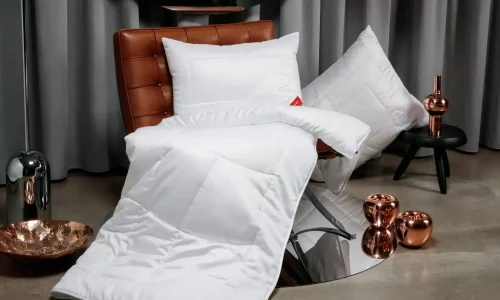
This bed linen from the Hoffmann linen weaving mill is as good as the trousseau your grandmother received. The linen bedding from the Hoffmann linen weaving mill is made from 100% pure linen. Linen bedding from Hoffmann has a climate-regulating effect, absorbs moisture and wicks it away in a controlled
The film shows it Is it striped lengthwise or crosswise? Scientists at MIT, the renowned Massachusetts Institute of Technology, discovered rather by chance that our choice of bed linen reveals something about our personality. People with a more emotional disposition prefer crosswise stripes, while bed linen with lengthwise stripes is
Geometric Weaving Technique Geometric patterns are very common in textiles for a simple reason. When weaving fabrics, threads cross horizontally and vertically. If two different colored yarns or threads are used, a geometric pattern automatically emerges. By far the oldest geometric pattern in textiles is the check. No, it was