







Geometric patterns and their effect

Geometric Weaving Technique

Geometric patterns are very common in textiles for a simple reason. When weaving fabrics, threads cross horizontally and vertically. If two different colored yarns or threads are used, a geometric pattern automatically emerges. By far the oldest geometric pattern in textiles is the check. No, it was not invented in Scotland. Its origins are found in China. Archaeologists discovered checked patterns on fabric hats for jade figures that are around 5500 years old. In Europe, it was the people who settled 2400 years ago in what is now Hallstatt, Austria, who first wore clothing with checked patterns, and as Celts, they ultimately brought the checked pattern to England and Scotland. There it became the quilt, the traditional bedspread, and of course the kilt, the Scottish skirt.

Just as weaving techniques did not stand still over millennia, neither did the check remain the sole geometric pattern. Particularly in linen bedding, this has created and continues to create an enormous scope for designers and weavers. Depending on the design, geometric patterns on bed linen can achieve various effects, even leading to optical illusions.

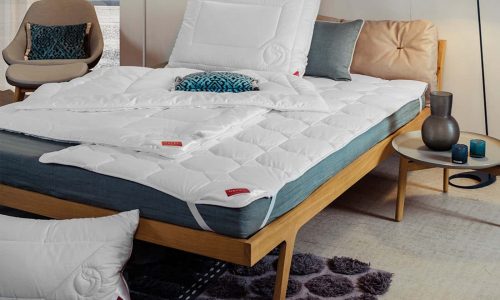
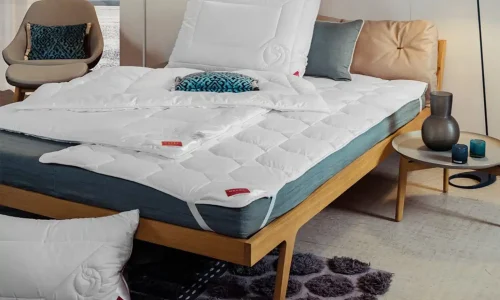
A neatly made bed with a geometric pattern duvet and several decorative pillows in shades of gray and purple, near a window with white curtains letting in natural light.

Bed Linen – Dreamy Geometry

They form the ideal basis for design ideas of the most diverse kinds. The basic geometric figures such as:

• Square
• Rectangle
• Trapezoid
• Rhombus
• Parallelogram
• Circle

In weaving as well as in textile printing techniques, an almost infinite number of different geometric patterns can be created from these 6 shapes alone. But nature itself also works with geometry, or rather, geometric forms arise from natural conditions. This is the case, for example, when weaving undyed linen. The flax fiber yarn has an individual structure with tiny nuances and very slight thickenings. This gives the linen fabric its own characteristic, almost like a fingerprint or an individual geometry.

Even the playful patterns of the Baroque, Rococo, or Art Nouveau are based on strict geometry. The shell, the tulip, or the chalice are exemplary templates for such geometric patterns, which are abstracted in bed linen design and ultimately often grow into magnificent creations. Examples include the Mariage bed linen or Toile-de-Jouy, both from Leitner Leinen. In contrast, the geometric patterns by Christian Fischbacher are subject to much clearer rules. Eternal Flower from the Luxury Nights collection is a good example of how bed linen can be stylishly designed with geometric patterns.

Similar characteristics are found in the bed linen from Genix, which evidently combines the rigor of geometry with the playfulness of natural forms. Geometric patterns are also good sleep aids, as their design invites dreaming, and that is a good goal for linen bedding.

Share

More Posts

Close-up of a white fabric with a visible cross pattern, showing a textured and slightly uneven surface. The threads form a subtle grid pattern on the fabric.
The 2017 Spring Collection by Christian Fischbacher

Christian Fischbacher’s spring 2017 collection is a modern interpretation of Art Deco. Christian Fischbacher’s spring 2017 collection entices with extraordinary designs. The designers demonstrate their style and creativity with the flagship model “Avantgardening,” as well as with the models “Selvados,” “Sir,” “Gentleman,” “Lord,” “Romanum,” and “Satin-Dessins Persis.” Its exclusive jacquard

Read more »
A bed in a bedroom next to a window.
Leitner linen: the best of both worlds

Romanticism loves mystery, just as many fairy tales do – Elixier by Leitner Leinen is covered with an intricate abstract design, like a misty veil. Woven with dark threads, it creates a mystical, twilight night effect, while light threads make it glow like fresh morning mist. A subtle yet impressive

Read more »
A bed with a blanket and pillows on it.
Linen is the queen of fabrics

What makes linen special Linen is the queen of fabrics. Quite often, returning to tradition really is the better choice. Before cotton arrived in Europe, household linens here were mainly made of linen, which is produced from flax. Flax is obtained from the fibres of the flax plant and is

Read more »

RELATED TO THIS POST

Our Recommendations

Hand-picked products from European manufacturers

Welcome back!

Register now

Before it begins

Some things we show first to those who know how to appreciate them.

  • Priority access to new collections.
  • Exclusive discounts.
  • Pre-order limited editions.
  • Insights into the work of our workshops
Newsletter Anmeldung

Welcome back!

Register now

Before it begins

Some things we show first to those who know how to appreciate them.

  • Priority access to new collections.
  • Exclusive discounts.
  • Pre-order limited editions.
  • Insights into the work of our workshops
Newsletter Anmeldung